Design assistants around your process. Connect the tools that move it forward. Keep the conversation, system actions and human decisions in one workflow.
Define the goal, approved knowledge, business rules and the points where a person must decide.
02
Compose richer journeys
Combine conversation branches, MCP tools, waiting states and human review.
03
Test the difficult paths
Explore interruptions, missing information and failed actions before a release.
04
Choose how it runs
Align the runtime with cloud, private-cloud or on-premises placement.
Responsiveness depends on providers, languages, network paths, system APIs and load. Deployment-specific latency targets are established through evaluation.
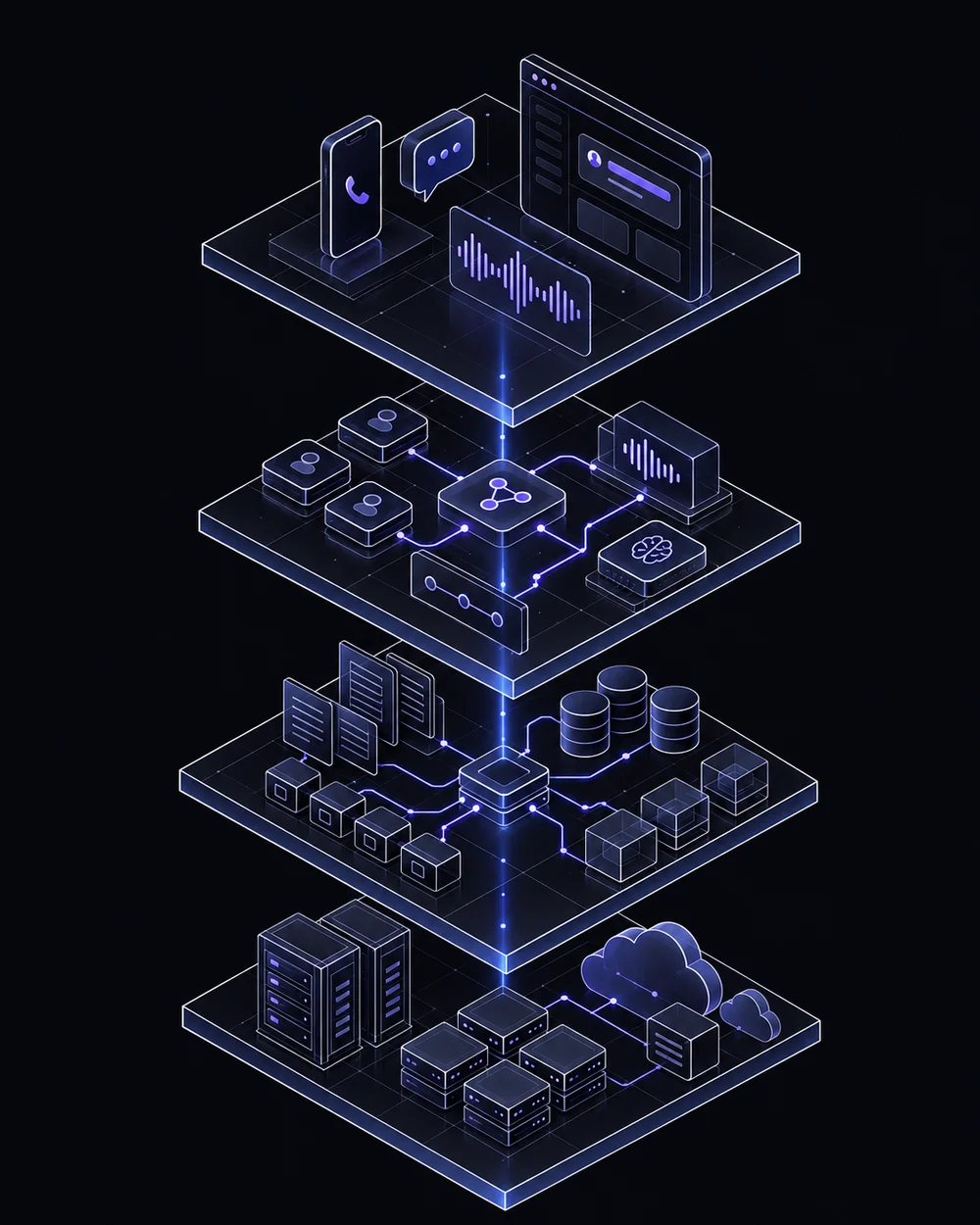
THE PLATFORM, LAYER BY LAYER
One platform. Four connected layers.
From the first conversation to the systems behind it. Each layer has a role; controls run through the whole process.
01
Channels & conversations
Voice, messaging, web and application events bring a request into one connected case.
Voice · Messaging · Web / app · Events
02
Workflow & assistant runtime
Your SOP defines the paths, state, approved actions and human hand-offs. Speech and reasoning services support the conversation.
Blueprint · State · Models · Assistant runtime
03
Connected systems & memory
APIs and events connect the workflow to enterprise records. Approved knowledge and stored context support the next step.
MCP / OpenAPI · Business systems · Knowledge
04
Your deployment boundary
Place the runtime and data in cloud, private cloud or on-premises infrastructure, with operations and permitted connections defined.
This site explains the supplied platform architecture. Specific feature availability, connectors and supported configurations are confirmed during product and deployment review.
START WITH ONE WORKFLOW
Bring your SOP. Let’s map the first process.
Define the task, connect the systems and agree what a useful pilot should prove.